Fiction
Oh, Tree of Mine
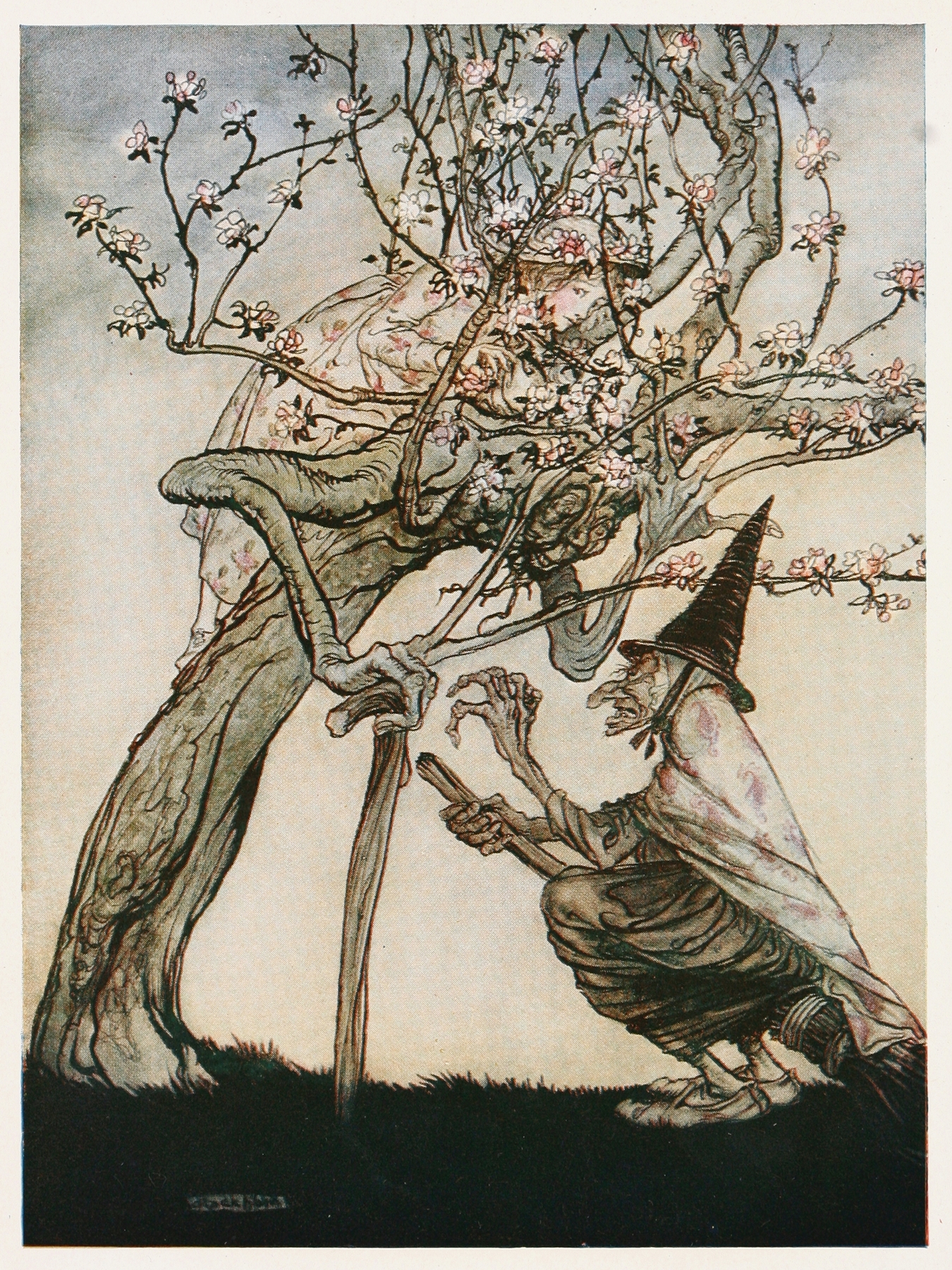
Figure 1: Arthur Rackham, "Tree of mine! O Tree of mine! Have you seen my naughty little maid?", 1918, watercolor and pen on paper, from Flora Annie Steel, English Fairy Tales, Macmillan & Co., London.
Not every witch’s curse is undeserved, but they all are punishing. Such was the case with Mallt, the old witch who lived deep in the forest. She loved to punish, and whether it was deserved made no difference to her.
Mallt maintained her plump physique because of the dismissive behavior of silly people who ignored their grandmothers’ tales. Pathetic adults and petulant children made good hearty stews. But babies were her favorite.
More fat.
Softer bones.
And they were surprisingly easy to come by.
~
Coegen lived in an idyllic little hamlet several miles from the local village. Her favorite day was market day, and she saved her best red dress for that occasion. She brushed her dark brown tresses till they shone in the sunlight, letting her long locks flow down her back. Gathering her basket and walking stick, she kissed her mother goodbye.
“Mind yourself today. Purchase only the items on my list, and don’t let the apothecary swindle you. That man is a thief! Be sure to open the bottles and smell them. Don’t just take his word for it.”
“Yes, Mother. I won’t forget. I never forget anything,” Coegen called over her shoulder as she headed out the door past her dozing grandmother and to the front gate.
“Stay clear of Mallt’s forest, child!”
“Goodness, Grandmother! You scared me half to death!” Coegen spun around. “I thought you were asleep.”
“Never be caught unaware, either by Mallt or young men.
Coegen rolled her eyes and walked to where her grandmother rested on a rickety chair against the house. Picking up the fallen basket of herbs from the ground, she placed them back on her grandmother’s lap and patted her wrinkled cheek.
“I said, I never forget anything, Grandmother.” She smirked before turning around to leave. The old woman’s obsession with the witch was ridiculous, and Coegen was tired of hearing about her and the stories of her devilish deals. “Anyway, Mallt isn’t real, so I don’t need to worry about her. Goodbye, Grandmother!”
As she closed the gate and stepped onto the road, her grandmother’s voice carried out to her, “You’ll see, child. You’ll see.”
~
Coegen dreamed of marrying the most handsome man, and she was certain the baker was not that man. No matter that he saved his best loaves for her and always asked after her mother and grandmother. Or that she caught his gaze following her everywhere.
Polite? Yes.
Handsome? No.
Only one man could compare with her own beauty, and he was the mayor’s son, Propryn. A young man equally confident in his appearance and just as determined to marry for looks as she was.
Making her way among the market stalls, Coegen longingly ran her fingers through the kaleidoscope of ribbons and lace in front of the haberdashery. Mother’s wrath would last well into the following week if she came home with even the tiniest snippet of the pale pink satin ribbon.
“That would look lovely in your hair. Or…perhaps tied prettily around your throat.”
Startled, she dropped her hand away and turned her head. Standing close to her and peering over her shoulder was Propryn. His smug smile proved he knew exactly how much he affected the women, and some men, around him.
“My apologies for frightening you,” he offered, bowing slightly. She simpered, tilting her chin down to look up at him through her fluttering eyelashes. It was her best attempt at flirtation, and it worked, for Propryn held out his arm for her. She eagerly placed her hand around his elbow.
“I will have your loaves packed and ready for you soon, Miss Coegen,” the baker called out to her from his stand.
“Thank you, good sir. I will return for them after I complete my other purchases,” she responded, dismissing him as her focus remained on Propryn.
As they strolled from stall to stall, their conversation was mostly Propryn speaking about one heroic adventure after another. Coegen didn’t mind that his tales rang false. He favored her over the other young maids, and that was all that mattered.
“Your bread, Miss. Coe—”
“Allow me!” Propryn grabbed the packages from the baker and tossed a small pouch of coins onto the table.
“Sire, this is too much,” said the baker, counting out the coins and handing back the excess.
“Keep it,” he responded, winking conspiratorially at the befuddled baker. “This beautiful angel is more than worth it.”
Coegen sighed, “But Sire—”
Propryn silenced her with a finger to her lips. “I asked you to call me by my name, Coegen. And I will brook no arguments.” He pulled her away from the baker’s stand, the poor man entirely forgotten.
She let him lead her to the edge of the town square. “Thank you, Propryn,” she said, taking the bread from him and putting it in her basket. “I best be getting home now. Mother will worry.” Coegen did not care if her mother was ever worried, but she knew that meek and timid young maidens were supposed to be biddable creatures. His patronizing smile proved her correct.
“Of course. What a joy and blessing you are to her,” he said as he lifted her hand, turned it over, and kissed the sensitive underside of her wrist. “I would like to call upon you tomorrow, if that is amenable.”
“It is.”
“Tomorrow, then.”
“Tomorrow…Propryn.”
~
The morning of her wedding was the happiest of Coegen’s life. Together, she and Propryn were radiant as they stood before the priest, and all in attendance remarked how the sun beaming through the stained-glass windows of the village church shone directly upon the happy couple. A sign from the Almighty himself.
The festivities carried on into the late evening for the mayor spared no expense. Wine and ale flowed freely, and no one imbibed more than Propryn and his friends. Coegen did her best to ignore the ribald jibes and crude assertions concerning the wedding night. Though she had learned over the past six months that her now husband was cruel, especially when in his cups, she still counted herself blessed. After all, if tradition kept, she would eventually be the mayor’s wife.
Alone in their bridal bedchamber, she stood rigid before a naked Propryn. Suddenly shy, she squeezed her eyes shut for fear of glimpsing his most male part as his hands lifted her shift up and over her head, leaving only the pale pink ribbon tied around her neck. The same one she discovered wrapped in paper underneath the loaves of bread.
At the feel of his hand around the back of her neck, she opened her eyes and stared into his as his thumb played with the tiny bow of the ribbon.
“A pretty adornment for an equally pretty wife,” he said, moving his mouth to hers.
“I have treasured it since that first day when you gave it to me, hidden amongst the bread.”
His brows furrowed and he stepped back. “I gave you no such gift. Is this a trick? Have you played me for a cuckold already?” He reached up, took hold of the ribbon and ripped it from her neck. The ferocity of his action surprised her, and she gasped, holding her hand over her throat. He stepped back and looked down at the torn strip of pink dangling from his fingers. When he looked back at Coegen, tears filled his eyes.
“My wife, my most beautiful wife, I am so sorry. I don’t—”
“Shhh, it was my mistake. Likely a surprise from my mother for running all her errands for her,” she said, rushing over to him and wrapping her arms around him. He embraced her back, burying his face in her neck, and Coegen felt the tickle of the pink ribbon down her back as it fell to the floor.
~
Ten years passed, and in that decade, Coegen became a mother. Eight times. Propryn became mayor, a role he prized over being a husband and father. Pregnant with what she guessed—based on the size of her belly—was her second set of twins, Coegen hefted herself through her mother’s garden gate for her monthly visit.
“It’s two babies again by the looks of you,” her mother said, placing a jug of mead and a plate of shortbread on the table.
“Yes, Mother. I do believe you are correct,” Coegen replied, her sarcasm thick as sap on a tree.
“Mind yourself, child,” her grandmother scolded from her seat at the foot of the table.
Ignoring the elderly woman, Coegen’s mother asked, “Do you think you will foster these babes out as well? I know you say it is the way of things in Propryn’s family, but I am sad that there are seven grandchildren I never see. Your firstborn, Arwyn, is a blessing to be sure, but I see little of him. Can you not bring him with you?”
“He is busy with his tutor, and the rest of the time, his doting father has need of him.” It was a lie, and her grandmother’s narrowed eyes suggested she was not fooled by the falsehood.
“Of course, of course. What a fine family you have, daughter. And your fertility as well as your pretty face proves that your husband made a splendid match the day he married you.
“Bah! You flatter one who doesn’t need any more flattery,” Grandmother scolded before she turned her scowl once again to Coegen.
“Grandmother is correct for once,” Coegen snickered.
“As many babes as you’ve born already, I wonder, child, how you still cling to your youthfulness? Why, I only bore four, and each ravaged my once pretty face,” her grandmother said.
“Some of us are just lucky, I guess,” Coegen replied, sneering at her grandmother.
Her grandmother scoffed in return, reached into the pocket of her threadbare apron, and pulled out a wrapped package. “This is for you. I’ve kept it these past ten years, thinking you unworthy. Oh, I still think that, but I fear for you, child.” Tossing the bundle across the table, she continued, “Here. Open it.”
Coegen undid the paper and out fell a short length of pale pink ribbon. The same as the one she wore on her wedding day. The gift she mistook for Propryn’s. “What is this?” she asked.
“Ribbon, you daft girl!”
“No, Grandmother. Who is this from?”
“The baker, of course! Do you not recognize the paper from his shop, or do you have someone purchase your bread for you now? Too high and mighty for such a thing, no doubt.”
“Cease! Tell me why the baker has given me this ribbon!”
“Because he loves you, though I told him he was a fool and better off without you, considering what his father did to his family.”
“You make no sense, old woman. Your ramblings speak to your addled mind,” Coegen said.
“Addled, is it? I warned you from the time you could walk to stay away from the witch in the woods, and I have my suspicions that you did not heed me.”
Coegen, cheeks reddened with guilt, stared down at the ribbons in her hands, unable to meet either woman’s eyes.
“Do you remember the baker’s father, my daughter?” the grandmother asked.
Coegen’s mother furrowed her brows in annoyance. “Barely. He disappeared ages ago, leaving his wife and son behind. Likely ran off to find a woman who could bear him more than one living son.”
“You are a fool just like your daughter,” the grandmother spat. “I will tell you both what really happened to him. Lack of living children wasn’t the old baker’s problem. It was too many of them. Too many mouths to feed, even though he was a baker and never short on bread. Still, each mouth meant more needed coin. This plagued the man and made him wish for things that no father should. And Mallt? Well, she can sniff out a wicked wish, even one never spoken. Especially the ones involving babies.”
“Grandmother, please stop.”
Ignoring her granddaughter, she continued. “One day, on his way home from the gristmill, he came upon a short stout woman dressed in black with a peculiar, pointed hat. There was something about her that made him stop to speak to her. Before he knew it, he had shared his plight with her. Thinking her a sympathetic ear to unburden himself, he spoke of his wish that he only ever had just the one son and he would do anything to go back in time to make it so. Mallt patted his knee, gave him a sweetmeat, told him all would be well, and sent him on his way home. When he arrived, he found only his wife and oldest son inside. The other children were gone. When he asked his wife where they were, she felt his head for fever thinking he was delirious. For you see, Mallt granted his wish. To most, those other children never happened. Only a few of us know the truth.”
“Doesn’t that make Mallt kind to grant the wish of someone in distress?” Coegen asked, her voice small, pleading. She gripped the ribbon tightly, her knuckles white with strain.
“Distress?! Complaining of mouths to feed when he had enough with which to feed them, even if it was not to his liking? He wasn’t distressed, child! He was selfish and stupid. As for Mallt, she didn’t just make those children disappear. She ate them!”
“Grandmother, stop lying!”
“She did! She feeds on children, but babies are her favorite. When the baker’s wife became pregnant again, he once again met Mallt on the road. She asked about the new child and when he would give it to her. When he refused, she thrust her bony finger up at him and cursed him to bake bread for her for all eternity. He was never seen again.”
At this, Coegen dropped the ribbon and covered her sobs with her hands.
Coegen’s mother stood from her stool, wrapped her arms around her daughter, and glared at the grandmother. “Look what you’ve done! You’ve upset her! And in her tender state!”
“Hush,” the old woman snapped. She looked then at Coegen and sighed. “What have you done? Where are your other children, you stupid girl?”
Coegen bolted up out of her mother’s embrace, knocking her chair over onto the floor. “She said she would take them for me. As long as I gave her any children save Arwyn, I would remain beautiful. That my husband would never again…hit me…or call me ugly. And he hasn’t! Obviously, he still comes to me,” she cried, waving towards her bulging belly. “And I am still beautiful! Propryn has his heir. Who cares where the others live?”
“You still think your children are alive? After what I just told you?”
“They are! I’m not the old baker! I didn’t wish for them to never exist!” She fell back into her chair; her face streaked with her tears. “I just didn’t want to be old and wrinkled. For Propryn.”
“You mean for yourself,” said the grandmother. “You need to end this with Mallt. Give these two babies in your belly to another family if you must. Give your husband herbs or take them yourself to prevent any more if you cannot do without your vanity. But feed no more to Mallt. I beg of you!”
Coegen sat silent before finally nodding in agreement. Then, dabbing her nose with her delicately embroidered handkerchief, she rose and quietly left.
~
A month later, Coegen gave birth to two girls. She left them with a childless couple far enough away that there would be no one to know where they came from. Her husband and others again believed her lie that the children were fostered and would return when they were older.
Several months after the birth, she felt well enough to make the walk to her mother’s home. On her way, a cackling voice called from the forest.
“Where are my babies?”
Coegen turned her head and froze as Mallt hobbled towards her. “I no longer need your kindness,” she said, doing her best to sound grateful yet confident. The witch laughed.
“But I need them. I’m hungry!”
“Please leave me be! I only wished to stay beautiful. I was foolish. I—”
“I granted your wish. We made a deal. I held my end of the bargain, and now you think to go back on yours. Do you know what happens to those who do?”
Thinking of the old baker, Coegen begged, “I did not know what you did with my children before. I do now. I would never have agreed to such a thing.”
“No matter,” Mallt said, waving her hand as if swatting away a fly. Her bones creaked in her short, crooked legs as she stepped close enough that Coegen’s stomach roiled from her fetid breath. Pointing a gnarled finger, Mallt uttered her curse, “For one so consumed with vanity, you will live for eternity as the oldest tree in my woods. Let all who come upon you mock your twisted limbs, rough bark, and wonder at the count of your rings inside. And because you fed me so well for so many years, you shall still bear much fruit, oh tree of mine. But no one shall relieve you of your burden anymore.”
And Coegen, the mayor’s beautiful wife, was never seen or heard from again.
Artist’s statement
My fascination with the untold stories of characters overlooked in fairy tales and folklore began at a young age and has continued here in “Oh, Tree of Mine.” Inspired by Arthur Rackham’s print (see below) from “The Two Sisters” in Flora Annie Steel’s English Fairy Tales, I wondered what magic brought such a tree into being, and so I created a story that shares its roots with readers. Much of my work does not attempt to rewrite the original stories, but rather to cultivate the hidden voices that were there all along and give them space to share their perspectives.